Showing posts with label analysis. Show all posts

Thursday, 29 January 2015

Casino Location overview

For our scene outside a nightclub, we decided to use the Casino. This was for both logical and eye-catching reasons!

We thought that the casino would be a highly logical setting, as there was a large car park around the back of it (so it would be safe for us to park, instead of going over double yellow line).

We believed it to be eye-catching to our genre, as it had hardly any lights around the car park. Therefore we could use it to our advantage to create a stereotypical dark setting. We also thought the casino was a good option, as its bright lights around the front an side were brilliant for showing the danger that approached. This is due to the fact that hey symbolised police search lights. Another reason for choosing the casino to drive past, was the fact that we could film the doctor looking up at it (this would be a low angle shot form his eye-line, representing his low level of authority/ bad personality).


Why we chose those characters

We chose a male aged 25, because:

  • doctors tend to start at the age of 25 (as this is the age medical students complete their degree), therefore we thought it would be good to portray our character at this age.
  • we opted for the youngest of the age group though, as stereotypically killers are of a younger generation. For example in Paul and Peter in 'Funny Games' (2007).
  • we chose a doctor, because we thought it would be a good link between his schizophrenia condition.
  • we thought our killer must be male as stereotypically males tend to play the part of killers
We chose a young female between 18- 22, because:
  • you have to be 18 to go to a club, and we wanted someone who could club (as that is the category of victims our killer is picking from)!
  • we chose to present our victim as smoking, as the whole reason behind our doctors serial of murders is due to the fact that people are abusing their bodies via smoke, drugs and drink.
  • it was best to use a female victim, as stereotypically females are seen as being more vulnerable.   

potential costume for our victim character

As a victim, we want her to be represented as innocent and pure. However as our doctor only kills those who abuse their bodies with drugs, drink or smoking, we want to portray the bad attitude within her. Therefore we have considered:

  • a stereotypical outfit for a teenager - jeans, t-shirt, jacket... I believe that this will show the fact that our victim was just a normal girl trying to have fun, when she was brutally murdered. I think that this will bring the audience to believe that the killer was out of line and that she was indeed a victim.
  • However, she could potentially as a cluber/ party girl be seen wearing the stereotypical 'bad-girl' outfit (a dress and leather jacket with high-heel shoes)!

Potential costumes for our main character

Our character as a doctor might wear:

  • suit - as those who are high up in the business tend not to wear scrubs but their own work clothes and a suit is a typical work costume.
  • scrubs - as he works in a hospital it may be that he has to wear scrubs if about to go into surgery, however it is unlikely that our doctor shall wear scrubs (as he isn't a surgeon or nurse). 
  • white lab coat - doctors who are high up often wear a white lab coat to distinguish themselves from ordinary hospital visitors.
As a killer, our character may wear:
  • a hoodie - as stereotypically killers are viewed as gangster who normally wear hoodies to hide their identity. Suggesting that there is something for them to hide.
  • jeans - it is stereotypical for killers to dress plain, as they don't want to be pin-pointed as a killer/ stand out to the police.
  • white t-shirt - again like the jeans it is stereotypical of a killer to wear something simple, to withdraw from standing out. 

Monday, 15 December 2014

Storyline Overview

Doctor 6:19

Beginning:

In the beginning of our film opening it features Joseph Damien sat down at his desk within his office and appears to be scribbling on a bible. I decided that a bible would link with our religious theme and his belief of certain quotes. Yet to show someone to be drawing on to something that is meant to be holy and reflex many teachings and stories that millions worldwide follow would be quite abnormal. No 'normal' person was even think of writing on to the bible, so shows the audience what kind of mind set Joseph has and what sort of character he may turn out to be within the rest of the story. It then shows joseph looking up and with the use of editing, shows him to be disorientated and focused on what he is writing/scribbling. We made sure that we filmed within an office which had a computer in it, this was because we could show our article about a 'Girl Murdered' in which would make the audience think about why he is so interested in it. It also does not give away whether he in fact has committed a murder or is just looking at the latest news. The next part shows Joseph slide over on his chair and open a lockable draw in which he has a case of photographs. These photographs are then placed on to his desk and shows our actor Sara as a murder victim inside a cellar. This then links joseph to his darker side which the viewers can now see clearer and features a flash back of his victim smoking outside.

Middle:

Our middle part of the opening sees a title wrote in a formal typewriter style come on to the screen and say 'Two days earlier', After our doctor is shown to walk out of the hospital and towards his big black car. I used one of my parents cars as it was big and black, so looked like the type a doctor would own and drive, this then saw him look across at his glove box in which the audience could see a knife and some sort of pills/drugs which were originally shown as a overlap in the beginning as being used for Schizophrenia, linking to his mental health. He then was shown driving off after looking mysteriously into the car mirror. Why did he have a knife and what was he going to do?

End:

Towards our ending, after seeing our doctor drive away from the hospital with a knife, we was shown driving through Guildford town centre and park up next to the Casino round the back in a alleyway. He then got out the knife from the glove box and got out of the car. This then features a overlap of Sara our victim running so acts as a flash forward giving the audience a preview of what he is going to do.

Rhianna Henson-Smith

Monday, 1 December 2014

Casino Location overview

Casino Location

As mentioned in my previous blog post on location we were thinking of filming next to the casino in Guildford town center. 
On the 30th of November myself and Sara filmed the remaining scenes for our opening which started from Joseph walking from the hospital to his car.
We decided to film him driving to the Casino and park round in an alley way seen in this photo (where the yellow door is). This way we were following our health and safety rules, as we did not get in the way of people, for example parking their cars and were out of site when scenes which involved the knife were used. At night time when we were filming we made sure there was an adult with us and that the camera always was put back into its holder when we were not using it. 
The location was a good choice as it had low lighting, which is a common convention of our genre and was mentioned in our audience interviews to make sure we had. This then would also be a good location to commit a murder, so links with our story. We decided it would be the Casino as it is a popular night club for young adults and is relatively close to our hospital location also.

Rhianna Henson-Smith

Saturday, 22 November 2014

Conventions of Psycological-Thrillers


Psychological thrillers and analysis


Through watching this montage of various psycho-thrillers, I can now tell that most films in this genre consist of dark lighting, eerie music, screaming, glitch editing/ effects and most importantly to emphasis a psychological aspect there is murmuring/ unusual behaviour amongst the characters.

Saturday, 8 November 2014

Representations of Bullet Boy


By Rhianna Henson-Smith

Actors Overview

Joseph Damien - acted by Matthew Foster

Our main character was a male doctor with schizophrenia who believes in 'Your body is a temple' from the bible. This therefore meant that we needed an actor who could look old enough to be a doctor so the audience did not get confused. As no members of our group had family members who were available, we set about finding our main character by asking older members of the sixth form. Matthew Foster was an excellent choice as he is also studying A-level drama and is a keen actor at heart. Matthew was more than happy to play Joseph Damien and came to our first filming day dressed as the character. I found our choice was good because he was easy to work with and as he got in to our character it made it easier to focus on filming and different shots, without worrying too much about acting. Matthew is quite a tall boy and when dressed as a doctor etc could look old enough to have that as his work profession.

Joseph's victim - Sara Campeggi

We decided to have a girl as josephs victim as they are seen as more vulnerable and cannot defend themselves as well as a man could against another male. We wanted our victim to be in her teens as they are more likely to trust others, especially a doctor who is known for helping people. Our character also being in her teenage years links well to our religious theme and his belief that 'your body is a temple' as this age group is more likely to abuse their bodies in some way, whether it be from alcohol, smoking or drugs. This is also why we show Sara smoking, therefore damaging her body which Joseph disagrees with. Sara was our main choice of actress as she is one of our media group members from Rising Suspense Productions and is within the right age range. Furthermore it allowed us to film her effectively when we needed her so we could get the camera work done for more editing time.

Rhianna Henson-Smith

Wednesday, 5 November 2014

Characters Costumes - Sara the victim

Characters costumes- Victim

Within most thriller films there are themes of death and crime. We wanted this within ours so therefore put together a motive for Joseph to want to commit murders. As our opening consisted of two characters, our second was Sara Joseph's victim.


From looking at other films and previous thriller openings I saw that the victim was usually dressed in casual day-to-day clothes and that they did not know the killer.


Sara's Outfit:
  • Navy coat
  • Black trousers
  • trainers
  • black bag
These listed above are typical of what teenage girls wear in society and linked to what we wanted her age to be.

Costumes of Characters - Joseph Damien

Characters Costumes - Joseph Damien

The only two characters we had within our opening were Joseph Damien and Sara his victim, we did this so that the main focus would be on Joseph and how he behaves.


From looking at types of costumes and watching thriller films such as Se7en, I have seen that the murderer usually is seen in dark and mysterious looking outfits, yet in the day time appears to look normal within their day-to-day activities and their profession. This therefore makes them appear like a normal person and fit in with the crowd, which they intend to do. From this I could then apply this to our characters costume within our opening.


Joseph Damien's outfits:
  • Smart shirt
  • black trousers
  • smart black leather shoes
  • red tie
  • black hoodie
From this the first 3 as listed above show his day time job as a doctor and shows him as being well-educated and professional, whereas the black hoodie contrasts this.
We decided to dress him in smart clothes as he would therefore appear as his characters role and look like he is the caring and compassionate doctor he should be or what the audience thinks he will be within the film. This also fulfils a doctors representation in society of being a role model and saving people's lives.
The black hoodie in the scenes where Joseph walks out of the hospital and then during the night time scenes reflex his mood. The outfit contrasts with the Doctor and shows his personal life and what kind of mind set he has outside work and during night time hours. We used a dark item of clothing as it makes Joseph more mysterious and especially in the dark builds up the tension as it makes him harder to see to others.
In the scene which shows him stepping out of his car from ground level, shows his shoes in which we wanted to point out to the audience that he is wearing odd socks. This shows that his tidy appearance within the first part of the opening is not all what it seems, which links with him not being the type of caring character a doctor is meant to be for the audience. The use of odd socks also conveys his mental state that he is not 'normal'.


Evaluation:
Overall I believe our characters costumes suited their role and what we were trying to portray. I think that the use of having a smart individual and the contrasting it with a dark clothed gangsta-like individual is good in showing his different personality and that he is not all what he appears. Although I liked our choice I would have also included him wearing a white lab coat and some doctor-like props such as a stethoscope, so that the audience is more clear on what profession he is in. This is because within the office he could also appear as a business man in smart clothes etc.

Sunday, 2 November 2014

The Ninth Gate opening


The Ninth Gate
In the first scene of the film "The Ninth Gate", an older, very wealthy and cultured gentleman, we can see it from the elegant costumes and the very elegant library room, calmly commits suicide by hanging himself from the chandelier, using a close up first of the chandalire and then of the feets, in his tastefully appointed library full of priceless rare books. Once his feet have stopped twitching, the camera pans across the shelves behind him to a vacant spot where one book is missing. As we later discover, that book is "The Nine Gates of the Kingdom of Shadows", a 17th century grimoire (1666 to be precise), said to have been co-authored by the Devil himself. Over the course of the film, five more people will suffer violent deaths because of their associations with this infamous book.
The opening is quite calm comparison to the rest of the film, but it still gives you the curiosity to finish the film.  
By Sara

Tuesday, 28 October 2014

Shutter Island Opening

Shutter Island Opening Sequence


 The first shot shows a dark, wet prison corridor with low lighting and shadows. There are no characters within this yet there appears to be a figure laying face down on the floor in a cell. This could link with a crime/ horror sub-genre as the audience is unaware if the figure is alive or not.  The music is mysterious and dramatic, while the corridor zooms in with water dipping down and lights fading out into darkness. The director Martin Scorsese, famous for thriller films, gives the audience a feel of what type of storyline it will be. 
 This scene shows a dark lit room with only a small window for light and a caged door slightly open. Water is shown dipping down to create a sense of mystery, usually associated with the thriller genre. There appears to be a cannon in the corner of the room, relating to themes of violence. The low lighting  effects the audiences senses creating a tension of what could happen.


 This features a close up of a mans hand, portraying that he is leaning down to uncover something under the floor by removing a floor board. This makes the audience contemplate what could be hidden under there and why it was hidden from others in the first place. The director has used a close up so the characters face, location and figure is not seen, creating a mystery of who it could be. 

 This shows four security guards dressed in their uniform opening wide two sets of metal gates to a location that is seen to be of high importance, closely monitoring who enters. In the distance there is a big building with small windows being blocked out of view by trees. The scene zooms closer to the second set of gates making it seem like you’re in a car driving in.
This is a close up of a high raised arm chair which blocks the focus so the audience cannot see who the character is that is sat on it.  The location is not shown giving mystery as to what could be going on. The actor “Ben Kingsley” is credited as he is clearly an important character within the film and promotes him in other previous roles.
This scene shows a mans black shoe resting on a shiny silver gun symbolising violence, relating to a sub-genre of crime and themes of murder  that are suggested to occur throughout. Yet again the director has chosen to use a close-up to not give the character away, so the audience continues to contemplate. Furthermore another very famous actor is credited  “Leonardo DiCaprio” who frequently appears in crime films. 
Simple text is used to not take the attention away from the scenes that are appearing and fading in and out in the background. Rain is commonly used within thriller genres as it creates a dark eerie mood, along with the low lighting throughout the opening.  
 This shows a prison looking location with little lighting, featuring chains and hand cuffs, portraying a theme of violence.

Yet again the character's face and figure is not shown making the audience wonder who it is. The lighting of the match shows that the scene is dark and there must be low lighting.
This is an establishing shot showing an Island that appears to only have a few buildings. As the title is "Shutter Island" it is apparent that this is where the majority of the film will be set, the lighting is dark still with low clouds making the island look even more mysterious.

By Rhianna Henson-Smith

Sunday, 12 October 2014

The Usual Suspects opening titles

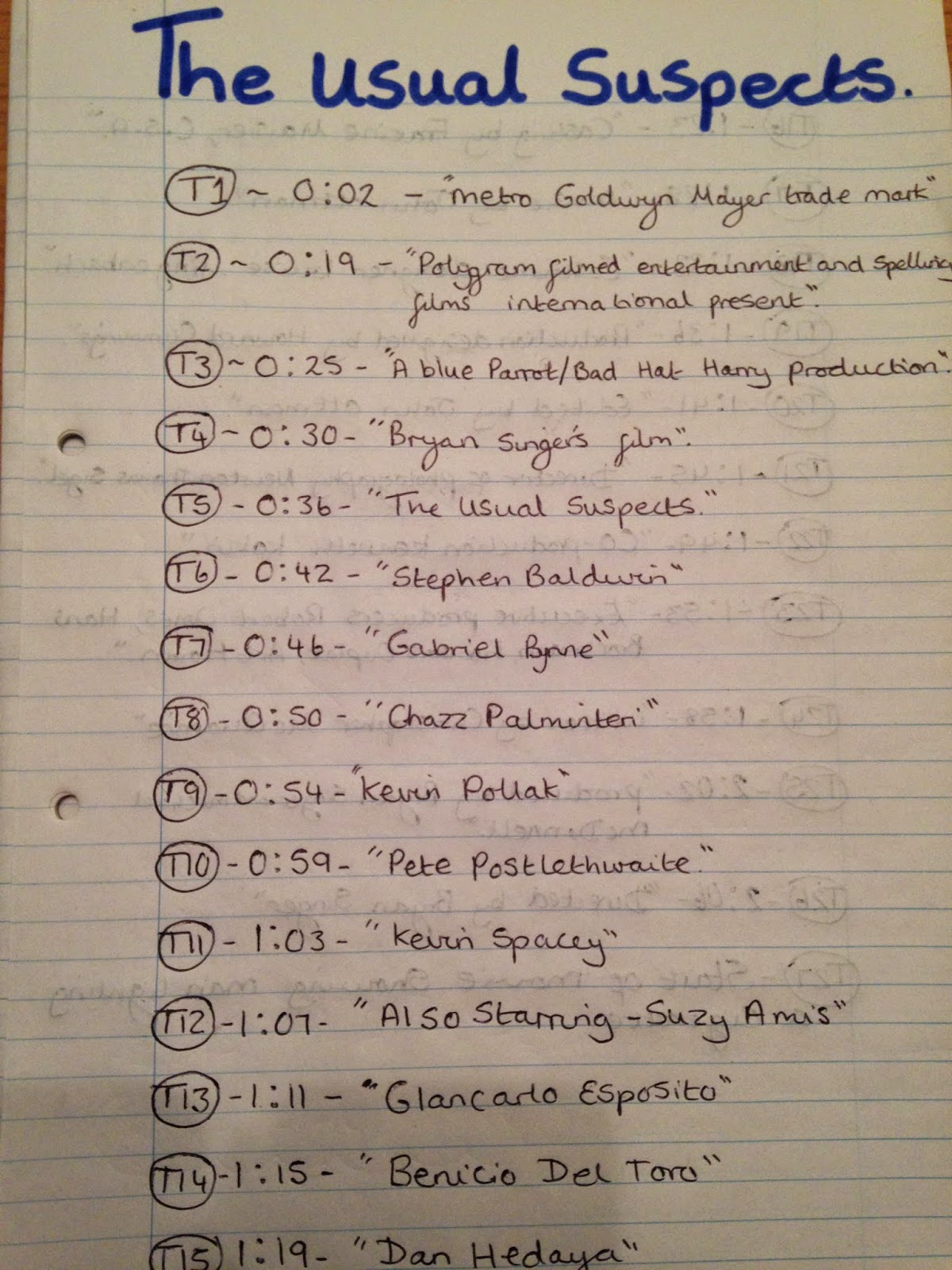
 Timeline of the opening titles

The opening titles consists of 26 credits, the first is at 0:02 saying "Metro Goldwyn Mayer trade mark" and at 0:19 "Polygram filmed entertainment and spelling films international presents". These credits come first as it shows what company's have been involved within the making of the film. At 0:25 "A blue parrot/bad harry production" Shows what production company has produced the film. This advertises their company and those that enjoy the film are more likely to follow future films and pervious movies of theirs. The first name mentioned in the credits is the director Bryan singer at 0:30, this is because he is the most important person of the film, each director has a type of genre their films normally are so the audience are aware what it is a thriller genre and of his style conventions. The films title "The Usual Suspects" appears at 0:36 and the cast members begin at 0:42 and finish at 1:19, these include the likes of Stephen Baldwin and Gabriel Byrne. Some audiences are attracted to a film for the cast members that they enjoy watching.
At 1:28 it says "Music by John Ottman" He is an important credit to the film as different types of music, for example orchestral, can create different types of emotions for the audience such as suspense and tension, which are key within a thriller genre that wants to undermine the audiences complacency throughout and wants them to stay watching. The credits then continue to mention those such as the costume designer at 1:32 and production designer at 1:36, until at 1:41 it gets to "editing by John Ottman" Editing is key in thriller genres, it can use slow pace to create suspense and fast pace to add to the action within scenes, along with other editing concepts. The co-production and executive producers are mentioned and at 1:58 it says "written by Christopher McQuarrine" the writer of the story is key for there to be a film, they are the main thinker and without them the plot would never have been thought up, let alone made into a film for audiences to watch. By Crediting the writer they are also being promoted, those that enjoy the film are more likely to read his pervious or up coming books. The final credit is at 2:06 and is "directed by Bryan Singer" The director has been mentioned twice within the opening as they are the main person who makes sure the film comes together.

By Rhianna Henson-Smith

Cape Fear (opening title sequence)


  •  During the opening of Cape Fear, credited roles appear in an order of importance. For instance the first title (at 00:27 seconds), is "amblin entertainment in association with Cappa films and Tribeca productions presents". This is an important title, as without the production teams listed; the audience wouldn't have a clue as to who the film was run by and what type of genre film it would be. For example Disney are well known for children's fantasy films, where as Tribeca (which was founded by Robert De Niro; who stars in this film) is better known for its more action-packed thriller type genres! 
  • At 00:33 seconds, the film states "a Martin Scorsese picture". This is an important title, as it explains to the audience who has directed it, suggesting to them what type of film techniques will most likely be used and perhaps what genre. For example, I know that Martin Scorsese used a blend of cinema - vérité techniques with the dreamlike imagery of avant-garde films. I also know that Scorsese filmed a lot of gangster films, period films or biopics, in which he explored many aspects of masculinity, identity and violence. (His protagonists were often loners in a chaotic world trying to make sense of the madness around them, grappling with issues of guilt, penance and spiritual enlightenment.)
  • After 00:47 seconds up until 01:27, all the key actors and actresses are mentioned. (Starting with "Robert De Niro" (the most crucial actor in this film/ main character), this could be the reason that his name is up on the screen the longest!) However the last four actors and actress are listed after an "and". This makes them seem more important/ bigger personalities then others within the film (best for last...).
  • From 01:31 up until 01:47, the title sequence purely lists those who worked on things such as props, casting... (behind the scenes). For example, it says "title sequence by Elaine & Saul Bass", this is there to show other production companies who worked on the film (so that if they were ever interested in their technique/style of work, they would know who's work it was). 
  • At 01:53 until 02:20, the opening title sequence list the varies production team members and the screenplay the film was based on and who wrote the screenplay used. For example, "produced by Barbarade Fina" and "based on a screenplay by James R.Webb and 'The Executioner's', a novel by John D.MacDonald". This allows the audience to research the book the film was based on, before it has actually come (whilst it's still just a trailer)!
  • The very last title, again states the the film was "directed by Martin Scorsese". This just goes to show that the Director gets the most credit; making his role a little more important than the rest (as he has to do a storyboard and plan every last detail of the film out)! 

Throughout the opening title sequence, the titles seem not to differ (constantly staying a jagged white font). This is to perhaps resemble an offline nature to the film, stating right from the beginning of the film that something is off-key! They font is also different in size depending on the words, for example, all the names are a lot larger than the job role listed. The style of font is also fairly modern, suggesting that the time the film was set was the time of which it actually came out (1991).


The genre of this film is thriller, we can learn this from the narrative of the film. For example:


  • The film starts of quite still/ calm, this can be shown through the use of a still river and the dull colours (nothing is out-of-the-ordinary).
  • However towards the end of the opening scene, the colours become more vibrant (with hints of yellow, green and red bursting through on the dull screen). This implies that the action of the film/ theme will grow deeper and more mysterious.
  • We can also see images starting to come through, for example, at 00:59-01:09 you can see an extreme close-up of a pair of wandering eyes, at 01:33-01:37 you can see a close-up of a face fade in and back out again and 02:13-02:16 there is a medium shot of a black silhouette of a man's body! These all start to suggest to the audience the type of characters that will be involved in the film. For instance, the fact the "Robert De Niro" is mentioned already starts to question the idea of a thriller (as he quite often stars in that genre of film).
  • Towards the end of the opening title sequence, you can see an extreme close-up of a pair of eyes (at 02:34-02:42), they first appear in red and then fade in to a bright, ghostly white. The camera then begins to zoom out, turning to a simple black and white (before eventually coming to plain colour). The camera is now showing a woman, and as she begins to speak, she describes Cape Fear as being a mystifying area. This is shown, by the mist outside the window (she looks as though she's in a classroom). 
  • She also goes on to say "magic would end and the real life would come crashing in".This suggests that everything used to be very happy and peaceful there (like paradise), however it has now turned nasty and grim (due to some type of devastating event. For instance someone may have drowned or been drowned, referring back to the extreme close-up of eyes at 01:00 under water.
In conclusion, I believe this film will endure plenty of heart-ache and distress for the characters involved. This is because even though nothing has really been given away in the opening title sequence, the use of dramatic orchestral/ eerie music catches the audience's attention and draws them into watching (as they can tell there will be some type of dramatic life-changing event for certain characters and want to know what)!  

By Maddy Fox

Saturday, 11 October 2014

Title sequence analysis of Seven

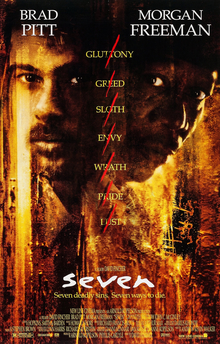
The title sequence of the film seven hasn't been studied depth, because as FIncher said:"The sequence for Se7en did very important non-narrative things; in the original script there was a title sequence that had Morgan Freeman buying a house out in the middle of nowhere and then travelling back on a train. He was making his way back to the unnamed city from the unnamed suburban sprawl, and that's where the title was supposed to be—"insert title sequence here"—but we didn't have the money to do that. We also lacked the feeling of John Doe, the villain, who just appeared 90 minutes into the movie. It was oddly problematic, you just needed a sense of what these guys were up against. Kyle Cooper, the designer of the title sequence, came to me and said, "You know, you have these amazing books that you spent tens of thousands of dollars to make for the John Doe interior props. I'd like to see them featured." And I said, "Well, that would be neat, but that's kind of a 2D glimpse. Figure out a way for it to involve John Doe, to show that somewhere across town somebody is working on some really evil shit. I don't want it to be just flipping through pages, as beautiful as they are." So Kyle came up with a great storyboard, and then we got Angus Wall and Harris Savides—Harris to shoot it and Angus to cut it—and the rest, as they say, is internet history.
But it's still a very good title opening because it capture your eyes and it's effective.
Sara Campggi

Thursday, 9 October 2014

Se7en opening titles

Se7en Opening Titles

Timeline of the opening titles:

There are 27 different credited roles which make up Se7en's opening titles. The first is "New Line Cinema Production" at 00:03 seconds. Which is important, as it informs the audience which production company was used and the director David Fincher in the third title at 00:10 seconds. This is key, because the audience can tell which style conventions are more likely to be used. After 00:13 seconds the opening titles go on to list the main actors within the film, for example Brad Pitt, Morgan Freeman and Gwyneth Paltrow. This gives the audience a clue as to what the genre of the film will be, from what pervious films they have featured in. 


An example is Morgan Freeman who plays God in Elvan Almighty  Brad Pitt who plays a spy in Mr and Mrs Smith, thereby they could be detectives of some sort within this.


The credited roles stop listing the main cast at 0.10, changing to "casting by Billy Hopkins, Suzanne Smith, Kerry Borden" of those behind the scenes and at 01:16 "music by Howard Shore". These are key to include within the titles because without music (orchestral) there would be little emphasise to the build up of tension seen within thriller genres. The sequence at 01:39 starts listing those who produced the film, "co-producers Stephen Brown, Nana Greenwald, Sanford Panilch", at 01:43 it says "co-executive producers Lynn Harris, Richard Saperstein" The producers are very important to be included within the opening as they organise the running of the scenes, making sure all of the actors and behind the scenes know exactly what they are doing.
Furthermore "written by Andrew Kevin Walker" appears at 01:53, which informs the audience who thought up the narrative and promotes him.  If the audience enjoyed the film they are more likely to like other books or films by the same author. At 02:05 David Fincher is credited for the second time, suggesting he is the most crucial role of the film and also like the writer, promotes him as a director and all of this other films. Lastly, “Monday" is the end title at 02:08, showing the audience where the film is starting off at.


The opening sequence does not include any long shots of the setting, but the audience assumes that the things taking place are happening in a home or inside an office as the props are what you would typically find in these places i.e razor blade. However the location is never shown therefore creating tension for the audience.                    

Mise en Scene - Props


• The props used in the opening could be associated with investigations and detective work. These include books, photos, files, pens and paper. It appears as if the person is putting pictures and information into one file or case, one of these is a word "God" which could link to a theme of religion being a key concept throughout.                   

• All of the objects are shown very close up and therefore they take up most of the frame.  This creates suspense as the audience do not know who the character is that is creating this file and doing these things as they cannot see their face or where they are.

• All of the shots are low lighting, this connotes danger and that the film will be quite serious with a  dull and suspicious feel.

• Most of the colours shown are black and white, however when the photos are shown being developed you see the red light that is used to develop them, this dark red connotes danger.

Editing


 • The opening is in a montage format, it is lots of different clips put together. The fact that it isn’t done in an chronological order that makes sense gives the idea that this person is doing many different things to create some sort of file or investigation about something, e.g. getting photos and writing information.

• The transitions vary, some are straight cuts and some cross fade or fade to black. The fading gives the effect of the clips being linked together and creates an eerie feel, and the fade to black reflects the sincerity and darkness of the overall film. 
                  

• Most of the shots are short, however some are edited into slow motion giving them a slower pace. The music is also slow, especially at the beginning which gives it a slow pace.  As the sequence builds up and gets faster towards the end, it creates tension for the audience, and shows that it will be a tens film to watch. 
                  

• They have done the clips in slow motion because it allows the audience to properly see what they are doing on the screen. There are also animations of flickering on the screen during some of the shots, used to create an eerie effect on the shots.
• The same two style fonts are used throughout, whenever a name is listed a child-like hand writing is used which could be a link to a psychologically disturbed adult. The handwriting also fits in with the idea of someone creating a file or investigation, as well as some of the props. The text appears in white which makes it stand out against the dark background. Where as the other part of the title is done using a formal font, linking to a more serious tone.

• Another is the enlargement of the title "Se7en". throughout suggesting that the word/ meaning of seven (seven deadly sins) has something to do with the plot of the film.

Camera work


• All of the shots are close up objects, for example of the books, a pen, photos etc, allowing the audience to focus on what is happening with these items as it may reflect the happenings in the film. It also distracts them from seeing who the person is that is doing these things which creates tension.
                   
• During the opening sequence, most of the camera shots are still. There is not much panning or any other kind of movement as all of the shots focus on one main thing and keep it at the centre of the shot.

By Rhianna Henson-Smith

Se7en (opening title sequence)


Timeline of the opening title sequence

There are 27 different credited roles, the order of which starts with the most crucial roles. For example, the first title is "New Line Cinema Production" at 00:03 seconds. This is an important title, as it informs the audience which production company was used. They also mentioned the director in the third title at 00:10 seconds. This is key, because the audience can tell which style conventions are more likely to be used, by that specific director (David Fincher). After 00:13 seconds the opening titles go on to list the main actors within the film, for example Brad Pitt, Morgan Freeman and Gwyneth Paltrow. This gives the audience a clue as to what the genre of the film will be, so in this film I know that Brad Pitt and Morgan Freeman quite often play 'good guys'. For example in Evan Almighty and Bruce Almighty, Morgan Freeman plays God and in R.E.D he sacrifices himself for the sake of others. This suggests that Brad Pitt and Morgan Freeman might be playing detectives!


 At 01:10 the credited roles stop listing the main cast, and start to list those behind the scenes. For instance at 01:10 the title changes to "casting by Billy Hopkins, Suzanne Smith, Kerry Borden" and at 01:16 the title yet again changes, this time saying "music by Howard Shore"... These titles are important to include in a film, because those who act behind the scenes create the atmosphere and theme within the film, (without them you wouldn't have dramatic/ orchestral music to build tension or certain lighting to suggest a type of setting/ atmosphere...). After listing those who used their skills to deliver  key clues to the audience (as to what the film will entail), at 01:39, the film begins to list those who produced the film. In this case, at 01:39 it states "co-producers Stephen Brown, Nana Greenwald, Sanford Panilch", at 01:43 it says "co-executive producers Lynn Harris, Richard Saperstein"... This important to note in the credited roles, as without the producers, things on the set of the film production wouldn't have been organised. This is due to the fact that producers and executive-producers help organise everyone with what they are doing; they make sure everything is in the right place and they make sure projects meet their deadlines! At the end of the credits, the titles include "written by Andrew Kevin Walker" (at 01:53). This is to help audience member's (who enjoyed this genre of film and this type of written technique) refer themselves to other similar films (perhaps written by 'Andrew Kevin Walker')! The second to last credit (again like the beginning of the titles), explains that the film was "directed by David Fincher" (at 02:05). It is important to mention David Fincher being credited twice, as it suggests he is the most crucial role related to the film!Lastly, the end title of the opening scene (at 02;08), is "Monday". This is informing the audience when the film is starting of from.


In the opening titles, the same two style fonts are used throughout. For instance whenever a name is listed a quirky/ child-like, hand-written type of font is used! This implies a childhood implement to the film (for example, someones childhood linking to a psychologically disturbed adult...). Where as the other part of the title, where it lists their role (for example, it says "a film by"...), is placed in a stamp-like font. This suggests that the film will have official meaning to it (e.g. police investigation...). During the opening scene, the titles have slight annotations. For example "an Arnold Kopelson production" is first presented backwards and within a flash flipped (so it is the right way around). This could have been done to present a dysfunctional theme to the film. 


Another slight annotation is the enlargement of the title "Se7en". The fact that it has been enlarged, suggests that the word/ meaning of seven has something to do with the plot of the film. (This could also be the reason for replacing the 'v' with the actual number'7'; to emphasis the word!)


During the opening scene of "Se7en", we can learn from the narrative that the film will be in the thriller genre. This is due to the fact, that the lighting is gloomy and dark (giving a hint of mystery), with hints of red (perhaps resembling blood; to give a hint of drama/ murder...). Another factor suggesting the red is implying blood on someones' hands, is the fact that someones hand is dipping an autopsy photograph into the blood (perhaps trying to wash the blood away from any evidence or the idea of someone printing the photo, suggests that they are 'the bad guy'...).


From the narrative:
  •  We can see props such as a blade (scrapping of finger prints), suggesting there will be criminals involved. This can be backed up by the drawing of hands placed on paper (resembling the process of fingerprints being taken).
  • We can see a notebook and someone writing in it, to suggest a type of investigation or someone keeping record of a plan/scheme...
  • There is a close-up of an American bill (suggesting the location of the film), it shows the word "In God We Trust" (implying a religious aspect to the film). E.G. the seven deadly sins (linking back to the title of the film).
  • We see the crossing out of eyes on photographs and of words/facts from books; maybe referring to some type of checklist...
  • There are also a lot of carefully placed down photos, fingerprints and stitches (evidence) in books. Implying that the film will be based on a crime-thriller.
  • We can also learn that whoever is being filmed within the opening scene is a very intelligent criminal. For example, he wears cotton wool around his fingers to protect his identity from the police!
  • I know that the person being filmed is a man, because of the size of his hands! 
In conclusion, the opening to "Se7en" has been very cleverly thought out and processed. This is in order not to reveal too much, yet to still give clues away, as to what the film will be about (the film must catch the audiences' attention, in order to get them to want to watch)!

By Maddy Fox