Monday, 13 October 2014

Taxi Driver Titles

After planning what our title for the film 'Taxi Driver' would look like, I went on to produce two versions of that plan. Overall when producing these titles, they didn't turn out exactly the same as we had planned for them to look. This is due to fact that our chosen images weren't easy to find on the internet and because my editing skills could be improved (that is a target for the next time I make a title).


Overall, I prefer the top title I produced. This is because it seems more realistic to me, compared to the bottom title which isn't as sleek!

When I was finished producing my two titles, I decided to have a look at what the actual title looked like from the film (as shown below). In conclusion, I think that I was similar in some aspects. For example, the font is yellow in all three (this is a referral to the colour of a taxi cab) and we both used black (to represent a dark plot)! However their title is in a diner-sign styled font and is shown in front of smoke (possibly exhaust fumes).


By Maddy Fox

Taxi Driver title plan

This is our rough idea for a title of the film Taxi Driver, we thought that we should use a simple/ bold styled font (so it doesn't draw any attention away from the skyline), however we would replace the last 'r' in driver with gun (to represent danger) and the title shall also act as a bridge for cars (the middle one being a typical American taxi cab; as its set in new York - the reason for the black silhouette of NY skyline) to cross on.


By Rhianna, Sara and Maddy

Practising how to make storyboard


(Die Hard 3)

Sunday, 12 October 2014

Representations/ different editing (own stills)

A homeless person gets litter thrown at them (as can be seen on the floor).
                                                                 So, the homeless person takes revenge and shots a person.
                                                             A friend mourns the deceased person (they can be seen crying).
The friend confronts the homeless person with a hidden agenda (behind the back).
The friend shots the homeless person out of anger.
  The killer disposes of the body in a dumpster. 
                                                         The killer closes the door to the dumpsters (looking suspiciously).
And disposes the evidence in a hedge.

The Usual Suspects opening titles

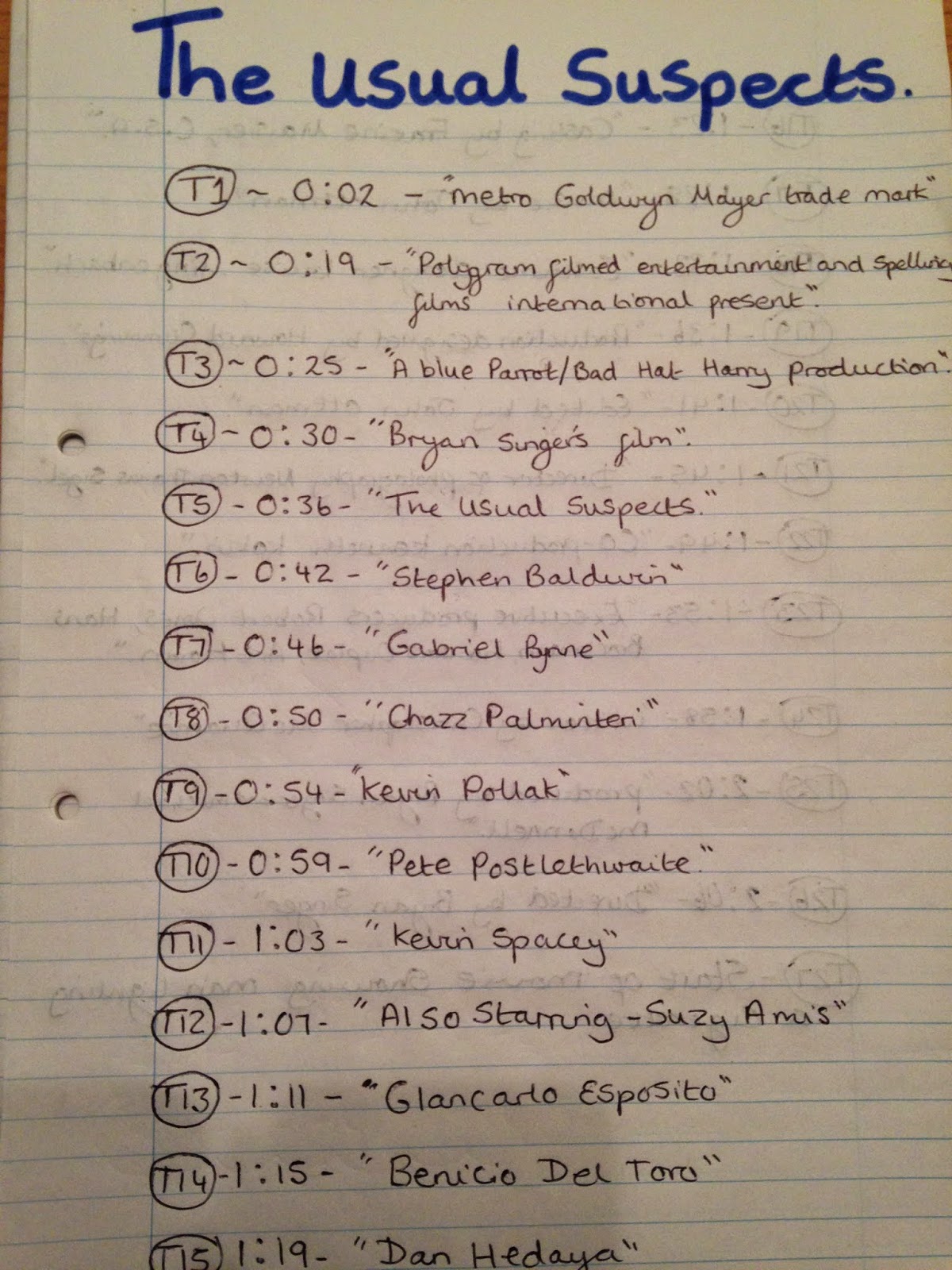
 Timeline of the opening titles

The opening titles consists of 26 credits, the first is at 0:02 saying "Metro Goldwyn Mayer trade mark" and at 0:19 "Polygram filmed entertainment and spelling films international presents". These credits come first as it shows what company's have been involved within the making of the film. At 0:25 "A blue parrot/bad harry production" Shows what production company has produced the film. This advertises their company and those that enjoy the film are more likely to follow future films and pervious movies of theirs. The first name mentioned in the credits is the director Bryan singer at 0:30, this is because he is the most important person of the film, each director has a type of genre their films normally are so the audience are aware what it is a thriller genre and of his style conventions. The films title "The Usual Suspects" appears at 0:36 and the cast members begin at 0:42 and finish at 1:19, these include the likes of Stephen Baldwin and Gabriel Byrne. Some audiences are attracted to a film for the cast members that they enjoy watching.
At 1:28 it says "Music by John Ottman" He is an important credit to the film as different types of music, for example orchestral, can create different types of emotions for the audience such as suspense and tension, which are key within a thriller genre that wants to undermine the audiences complacency throughout and wants them to stay watching. The credits then continue to mention those such as the costume designer at 1:32 and production designer at 1:36, until at 1:41 it gets to "editing by John Ottman" Editing is key in thriller genres, it can use slow pace to create suspense and fast pace to add to the action within scenes, along with other editing concepts. The co-production and executive producers are mentioned and at 1:58 it says "written by Christopher McQuarrine" the writer of the story is key for there to be a film, they are the main thinker and without them the plot would never have been thought up, let alone made into a film for audiences to watch. By Crediting the writer they are also being promoted, those that enjoy the film are more likely to read his pervious or up coming books. The final credit is at 2:06 and is "directed by Bryan Singer" The director has been mentioned twice within the opening as they are the main person who makes sure the film comes together.

By Rhianna Henson-Smith

Cape Fear (opening title sequence)


  •  During the opening of Cape Fear, credited roles appear in an order of importance. For instance the first title (at 00:27 seconds), is "amblin entertainment in association with Cappa films and Tribeca productions presents". This is an important title, as without the production teams listed; the audience wouldn't have a clue as to who the film was run by and what type of genre film it would be. For example Disney are well known for children's fantasy films, where as Tribeca (which was founded by Robert De Niro; who stars in this film) is better known for its more action-packed thriller type genres! 
  • At 00:33 seconds, the film states "a Martin Scorsese picture". This is an important title, as it explains to the audience who has directed it, suggesting to them what type of film techniques will most likely be used and perhaps what genre. For example, I know that Martin Scorsese used a blend of cinema - vérité techniques with the dreamlike imagery of avant-garde films. I also know that Scorsese filmed a lot of gangster films, period films or biopics, in which he explored many aspects of masculinity, identity and violence. (His protagonists were often loners in a chaotic world trying to make sense of the madness around them, grappling with issues of guilt, penance and spiritual enlightenment.)
  • After 00:47 seconds up until 01:27, all the key actors and actresses are mentioned. (Starting with "Robert De Niro" (the most crucial actor in this film/ main character), this could be the reason that his name is up on the screen the longest!) However the last four actors and actress are listed after an "and". This makes them seem more important/ bigger personalities then others within the film (best for last...).
  • From 01:31 up until 01:47, the title sequence purely lists those who worked on things such as props, casting... (behind the scenes). For example, it says "title sequence by Elaine & Saul Bass", this is there to show other production companies who worked on the film (so that if they were ever interested in their technique/style of work, they would know who's work it was). 
  • At 01:53 until 02:20, the opening title sequence list the varies production team members and the screenplay the film was based on and who wrote the screenplay used. For example, "produced by Barbarade Fina" and "based on a screenplay by James R.Webb and 'The Executioner's', a novel by John D.MacDonald". This allows the audience to research the book the film was based on, before it has actually come (whilst it's still just a trailer)!
  • The very last title, again states the the film was "directed by Martin Scorsese". This just goes to show that the Director gets the most credit; making his role a little more important than the rest (as he has to do a storyboard and plan every last detail of the film out)! 

Throughout the opening title sequence, the titles seem not to differ (constantly staying a jagged white font). This is to perhaps resemble an offline nature to the film, stating right from the beginning of the film that something is off-key! They font is also different in size depending on the words, for example, all the names are a lot larger than the job role listed. The style of font is also fairly modern, suggesting that the time the film was set was the time of which it actually came out (1991).


The genre of this film is thriller, we can learn this from the narrative of the film. For example:


  • The film starts of quite still/ calm, this can be shown through the use of a still river and the dull colours (nothing is out-of-the-ordinary).
  • However towards the end of the opening scene, the colours become more vibrant (with hints of yellow, green and red bursting through on the dull screen). This implies that the action of the film/ theme will grow deeper and more mysterious.
  • We can also see images starting to come through, for example, at 00:59-01:09 you can see an extreme close-up of a pair of wandering eyes, at 01:33-01:37 you can see a close-up of a face fade in and back out again and 02:13-02:16 there is a medium shot of a black silhouette of a man's body! These all start to suggest to the audience the type of characters that will be involved in the film. For instance, the fact the "Robert De Niro" is mentioned already starts to question the idea of a thriller (as he quite often stars in that genre of film).
  • Towards the end of the opening title sequence, you can see an extreme close-up of a pair of eyes (at 02:34-02:42), they first appear in red and then fade in to a bright, ghostly white. The camera then begins to zoom out, turning to a simple black and white (before eventually coming to plain colour). The camera is now showing a woman, and as she begins to speak, she describes Cape Fear as being a mystifying area. This is shown, by the mist outside the window (she looks as though she's in a classroom). 
  • She also goes on to say "magic would end and the real life would come crashing in".This suggests that everything used to be very happy and peaceful there (like paradise), however it has now turned nasty and grim (due to some type of devastating event. For instance someone may have drowned or been drowned, referring back to the extreme close-up of eyes at 01:00 under water.
In conclusion, I believe this film will endure plenty of heart-ache and distress for the characters involved. This is because even though nothing has really been given away in the opening title sequence, the use of dramatic orchestral/ eerie music catches the audience's attention and draws them into watching (as they can tell there will be some type of dramatic life-changing event for certain characters and want to know what)!  

By Maddy Fox

Saturday, 11 October 2014

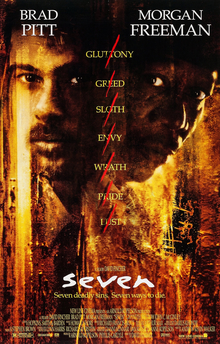
Title sequence analysis of Seven

The title sequence of the film seven hasn't been studied depth, because as FIncher said:"The sequence for Se7en did very important non-narrative things; in the original script there was a title sequence that had Morgan Freeman buying a house out in the middle of nowhere and then travelling back on a train. He was making his way back to the unnamed city from the unnamed suburban sprawl, and that's where the title was supposed to be—"insert title sequence here"—but we didn't have the money to do that. We also lacked the feeling of John Doe, the villain, who just appeared 90 minutes into the movie. It was oddly problematic, you just needed a sense of what these guys were up against. Kyle Cooper, the designer of the title sequence, came to me and said, "You know, you have these amazing books that you spent tens of thousands of dollars to make for the John Doe interior props. I'd like to see them featured." And I said, "Well, that would be neat, but that's kind of a 2D glimpse. Figure out a way for it to involve John Doe, to show that somewhere across town somebody is working on some really evil shit. I don't want it to be just flipping through pages, as beautiful as they are." So Kyle came up with a great storyboard, and then we got Angus Wall and Harris Savides—Harris to shoot it and Angus to cut it—and the rest, as they say, is internet history.
But it's still a very good title opening because it capture your eyes and it's effective.
Sara Campggi